Not legal advice. This is general information, not legal advice. It does not create an attorney-client relationship.
Key facts
- Receiving a Departure Order or Forced Deportation Order does not mean your case is hopeless — foreign residents have constitutional rights to challenge administrative decisions under South Korean law.
- Under the Korean Immigration Control Act, you can file an Administrative Objection, an Administrative Lawsuit, and crucially, an emergency Stay of Execution to legally remain in Korea while your case is litigated.
- By retaining a licensed Korean immigration attorney, you can challenge administrative abuses of discretion, present humanitarian mitigating factors (family ties, long-term employment, lack of criminal intent), and seek complete visa reinstatement or voluntary exit conversion.
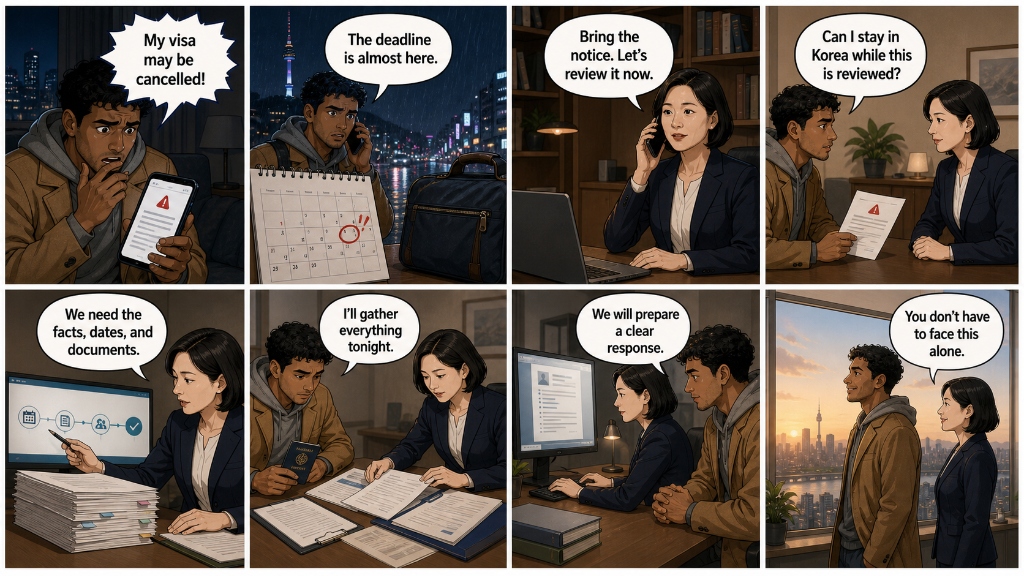
1. Common Triggers for Visa Revocation & Immigration Review
Under Articles 11, 46, and 68 of the South Korean Immigration Control Act, the Ministry of Justice has broad administrative authority to revoke visas, deny extensions, or issue deportation orders. Common grounds include overstaying a visa, unauthorized employment or workplace departure (especially for E-9, E-7, or D-2 visa holders), submitting fraudulent documents during visa application, or being convicted of a criminal offense in Korea.
Foreign residents are often surprised to learn that even non-violent criminal convictions or summary fines trigger mandatory Immigration Offense Reviews. Under Korean immigration practice guidelines, receiving a fine of 3,000,000 KRW or higher for a single incident, or cumulative fines exceeding 5,000,000 KRW over 5 years, almost automatically leads to visa cancellation and departure orders unless aggressive legal defense is mounted.
2. Departure Order vs. Forced Deportation & Re-entry Bans
It is vital to understand the severe legal difference between a Departure Order under Article 68 and a Forced Deportation Order under Article 46. A Departure Order directs the individual to voluntarily exit South Korea within a specified timeframe, typically 14 to 30 days. Voluntary departure generally results in a significantly shorter re-entry ban and avoids physical detention at an immigration facility.
Conversely, Forced Deportation is the most severe administrative penalty. It involves physical detention at an immigration processing center such as the Hwaseong or Cheongju Detention Centers, followed by forcible escort onto an outbound aircraft. Forced deportation carries lengthy re-entry bans: typically 1 to 2 years for minor overstays, 3 to 5 years for criminal fines, and up to 10 years or permanent re-entry bans for drug offenses or felonies.
3. Emergency Defense Mechanism: Injunction for Stay of Execution
The most critical legal rule foreign residents must understand is that filing an administrative appeal or lawsuit does not automatically suspend a deportation order. Without specific court intervention, immigration authorities can legally deport you even while your lawsuit is pending.
To prevent immediate removal, your immigration attorney must file an urgent Application for Injunction and Stay of Execution simultaneously with the Administrative Lawsuit at the administrative court. Under Article 23 of the Administrative Litigation Act, Korean courts grant a Stay of Execution if immediate deportation would cause irreparable harm to the applicant's livelihood, child custody, or family stability. Once granted, your deportation is legally frozen, and you can remain in Korea on temporary status under a G-1 visa extension until a final court verdict is reached.
4. Challenging Administrative Abuse of Discretion & Humanitarian Petitions
In Korean administrative court litigation, the primary defense argument is Abuse of Discretionary Power. The court evaluates whether the immigration office's decision was excessively punitive when balanced against the foreigner's positive contributions, lack of malicious intent, and humanitarian hardship.
Key mitigating factors that courts weigh heavily include: being married to a Korean citizen under F-6 status, raising minor Korean national children, caring for elderly family members, long-term tax payment history, lack of prior criminal record, and sincere remorse. An experienced attorney builds a compelling evidentiary dossier including character references, family dependency proofs, and medical records to petition the Ministry of Justice for ban mitigation or complete visa restoration.
Emergency Action Checklist: What to do in the first 72 hours of receiving an immigration notice
- Do NOT sign any voluntary departure agreements, confession statements, or waiver documents at the immigration office without fully understanding them or consulting an attorney.
- Demand an official written copy of the Administrative Disposition Notice specifying the exact legal statutory grounds, immigration review date, and departure deadline.
- Note the exact date and time of service — administrative lawsuit deadlines (90 days) and administrative objection deadlines (7 days) are strictly calculated from the date you receive official notice.
- Immediately compile all evidence of your ties to South Korea: marriage certificates, minor children's birth certificates, employment contracts, tax payment receipts, bank statements, and recommendation letters.
- Retain a specialized Korean immigration defense attorney immediately to file an emergency Court Injunction for Stay of Execution before your designated departure date passes.
Potential Legal Defense Outcomes & Remedies
Emergency Stay of Execution
Court ruling granted within 7 to 14 days of application
Freezes deportation proceedings and allows you to legally remain in South Korea under valid protection with a G-1 temporary extension while your administrative lawsuit proceeds.
Visa Reinstatement & Disposition Overturn
Complete cancellation of departure order or deportation disposition
The court rules that the immigration office abused its discretion, fully restoring your legal residency status and clearing administrative entry blacklists.
Conversion to Voluntary Exit & Ban Reduction
Reduction of re-entry ban from 5 years to 6 months – 1 year
If full visa reinstatement is unfeasible, converting forced deportation to voluntary departure prevents physical detention and dramatically shortens mandatory re-entry bans.
Quick answers
Can I legally remain in Korea while my administrative lawsuit is ongoing?
Yes, BUT ONLY if your attorney successfully obtains an Injunction for Stay of Execution from the administrative court. Simply filing a lawsuit does not automatically pause deportation. Once the stay is granted, the immigration office extends your temporary stay under a G-1 visa extension until the court renders a final verdict.
What criminal fine amount triggers automatic visa cancellation in Korea?
Under Korean immigration practice guidelines, receiving a criminal fine of 3,000,000 KRW or higher for a single offense, or cumulative fines exceeding 5,000,000 KRW over 5 years, triggers a mandatory Immigration Offense Review, which frequently leads to visa revocation or departure orders.
I am married to a Korean citizen under F-6 status or have Korean children. Does this protect me from deportation?
Family ties do not grant automatic immunity, but they serve as the single strongest mitigating defense in administrative court. Under Supreme Court precedents, administrative dispositions that cause the forced separation of a married couple or separate foreign parents from minor Korean children are frequently struck down as an unconstitutional abuse of discretion.
What happens if I am detained at the Hwaseong or Cheongju Immigration Detention Center?
If detained under a Forced Deportation Order, your attorney can immediately file a Petition for Temporary Release from Detention on medical, humanitarian, or legal defense grounds, alongside an urgent court injunction to stop physical removal from South Korea.
How long do I have to file a lawsuit after receiving a departure notice?
Under Article 20 of the Administrative Litigation Act, you have 90 days from the date you receive official notice of the administrative disposition to file an administrative lawsuit. However, because departure deadlines are usually set to 14–30 days, you must file the lawsuit and Stay of Execution application within days of receiving the notice.
Can I pay with international credit cards or cash in Korea?
Most stores, restaurants, and taxis in Korea accept international Visa, Mastercard, and AMEX. However, public transportation card recharges (T-Money) and traditional street food markets require Korean Won (KRW) cash.
Is there a 24/7 English tourist helpline in Korea for urgent questions?
Yes! The Korea Tourism Organization operates the 1330 Korea Travel Helpline, providing free 24/7 assistance in English, Japanese, and Chinese for directions, translation, and tourist complaints.
Reviewed by
Attorney at Law, licensed in the Republic of Korea
Bubshin Law Firm