Not legal advice. This is general information, not legal advice. It does not create an attorney-client relationship.
Key facts
- Under Korean Family Court practice, foreign spouses have equal legal standing to claim 30%–50% of marital property division, claim alimony, and secure primary child custody based on the child's welfare.
- In South Korea, if both spouses agree on divorce, property, and custody, a Consensual Divorce can be finalized. However, if the Korean spouse refuses to cooperate, foreign nationals can file a Judicial Contested Divorce under Article 840 of the Korean Civil Code.
- Strategic coordination between family court litigation and immigration law is essential to preserve your F-6 Marriage visa or transition to F-5 Permanent Residency.
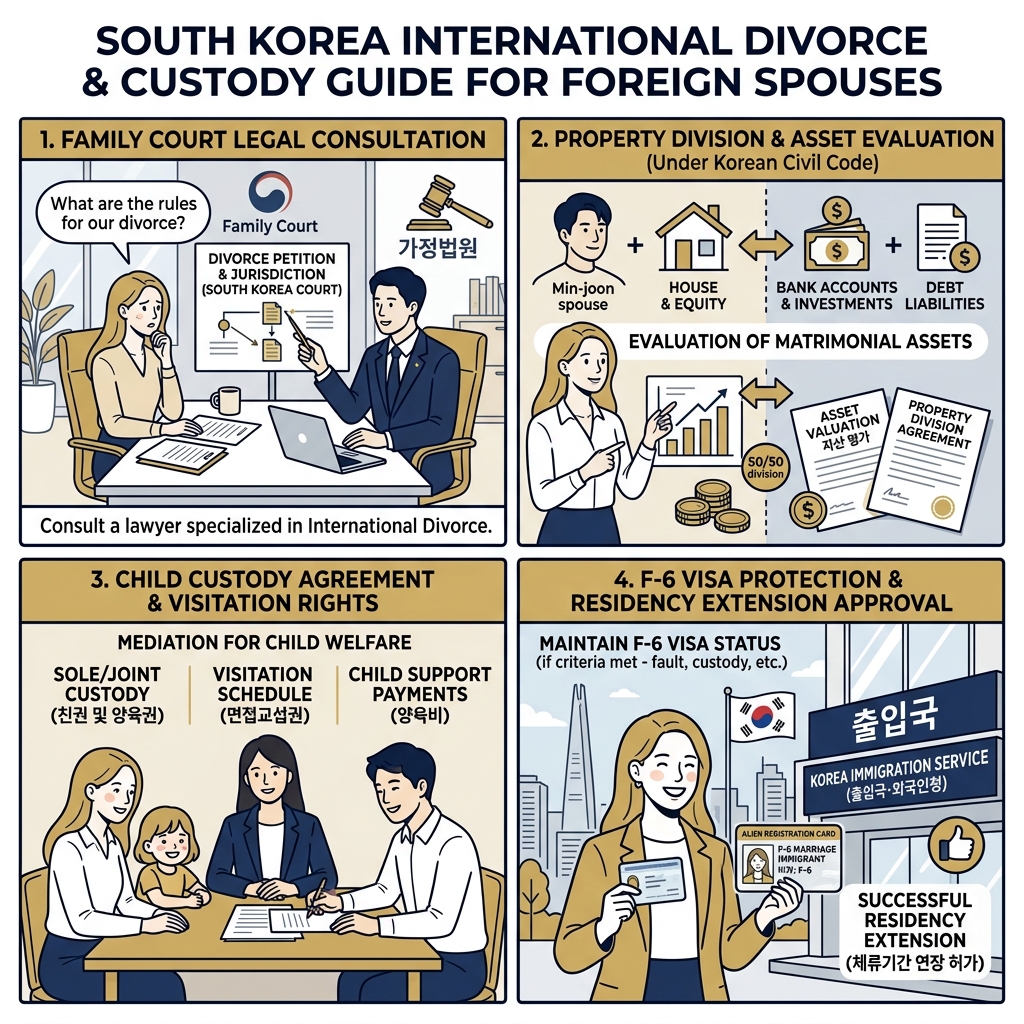
1. Consensual vs. Contested Divorce in Korea
In a consensual divorce, both spouses agree on all terms, including property division and child custody. They must attend court together to confirm their intent, undergo a mandatory reflection period (typically 1 to 3 months), and then finalize the divorce.
When spouses cannot agree, a contested divorce must be filed under Article 840 of the Civil Code. Legal grounds include infidelity, malicious desertion, physical/verbal abuse, or severe breakdown of marital relations. Contested lawsuits take 6 to 12 months, requiring thorough evidence presentation.
2. Child Custody & Visitation Rights for Foreign Parents
Korean family courts determine child custody based strictly on the best interest of the child. Courts evaluate emotional bond, primary caregiver history, financial environment, and educational stability.
Non-custodial parents are entitled to statutory visitation rights, typically granting bi-weekly weekend visits, school holiday stays, and regular phone/video access.
3. Marital Property Division Principles
Property division in a Korean divorce encompasses all assets accumulated during the marriage, including real estate, bank savings, insurance cash values, stock investments, severance pay, and pensions.
Courts recognize non-financial contributions such as homemaking and childcare. Foreign spouses who served as primary homemakers routinely receive 30% to 50% of marital assets.
4. F-6 Marriage Visa Protection & Status Transition
Divorce without children under consensual terms usually leads to F-6 visa cancellation. However, if the court rules that the divorce was primarily caused by the Korean spouse's fault, foreign nationals can extend their F-6 visa independently.
If raising minor Korean national children, foreign parents can retain their F-6-2 visa regardless of divorce terms. Furthermore, meeting income/residency criteria allows transition to an F-5 Permanent Residency visa.
Essential Action Checklist for Divorce in Korea
- Do NOT sign consensual divorce agreements without verifying visa impact with a legal expert.
- Secure copies of bank statements, real estate registry documents, and tax filings to establish marital assets.
- Gather evidence of spouse fault (text logs, medical reports, police dispatch records) for contested divorce filings.
- Maintain detailed daily records proving your role as primary caregiver for your minor children.
- Consult an attorney experienced in international family litigation and ROK immigration law.
Key Legal Outcomes & Property Entitlements
Child Custody & Enforceable Visitation
Primary custody or structured weekend/holiday visitation
Secures legal parental rights and ongoing relationship with your children.
Fair Marital Property Division
30% to 50% of total marital assets accumulated during marriage
Includes real estate, savings, pensions, and severance pay.
F-6 Visa Retention or F-5 Transition
Continued legal residency in South Korea
Protects your visa based on child rearing or Korean spouse fault ruling.
Quick answers
Can I take my child abroad after a Korean divorce?
If you have primary custody, generally yes, but it is highly recommended to have this explicitly agreed upon or court-ordered to prevent claims of international child abduction.
What happens to my F-6 visa after divorce?
Your F-6 visa is at risk unless you have custody of Korean children, the divorce was 100% your spouse's fault, or you transition to another visa.
How long does a contested divorce take in Korea?
A contested divorce in Korea typically takes between 6 months to over a year, depending on the complexity of property division and custody disputes.
Can I pay with international credit cards or cash in Korea?
Most stores, restaurants, and taxis in Korea accept international Visa, Mastercard, and AMEX. However, public transportation card recharges (T-Money) and traditional street food markets require Korean Won (KRW) cash.
Is there a 24/7 English tourist helpline in Korea for urgent questions?
Yes! The Korea Tourism Organization operates the 1330 Korea Travel Helpline, providing free 24/7 assistance in English, Japanese, and Chinese for directions, translation, and tourist complaints.
Reviewed by
Attorney at Law, licensed in the Republic of Korea
Bubshin Law Firm