Not legal advice. This is general information, not legal advice. It does not create an attorney-client relationship.
Key facts
- Under Article 260 of the South Korean Criminal Act, assault carries penalties of up to 2 years imprisonment or fines up to 5,000,000 KRW. Even minor physical contact during a dispute can lead to police investigation.
- Crucially, simple assault is a non-prosecution over objection crime. If an agreement and written non-punishment petition are secured from the victim before prosecution, police/prosecutors MUST dismiss the charges without criminal records.
- For foreign residents, avoiding a criminal fine of 3,000,000 KRW or higher is critical to pass Ministry of Justice Immigration Offense Reviews and protect E-7, F-2, F-4, or F-6 visa renewals.
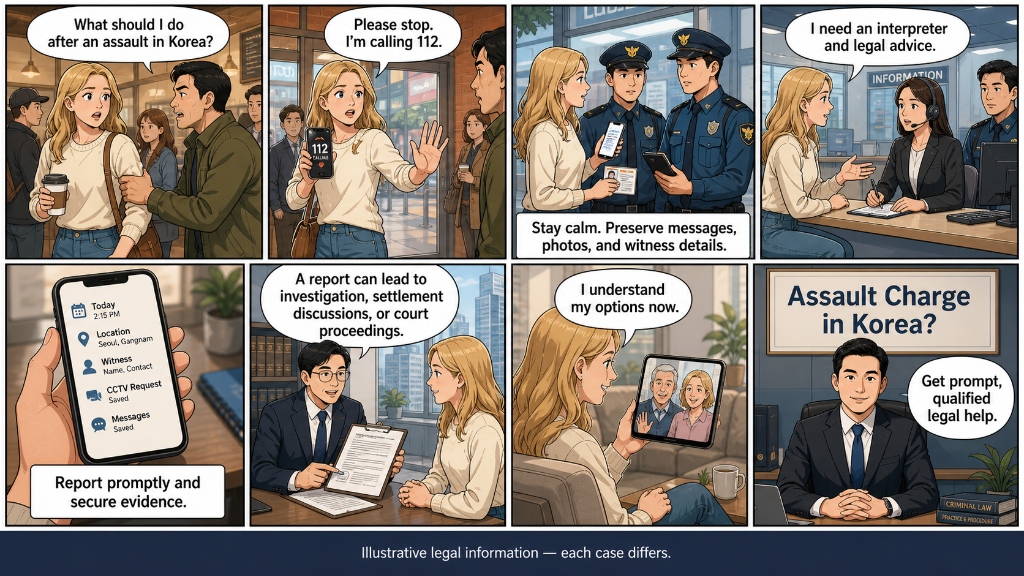
1. Simple Assault vs. Bodily Injury under Korean Criminal Act
Korean criminal law distinguishes sharply between Simple Assault (Criminal Act Art. 260) and Bodily Injury (Criminal Act Art. 257). Simple assault covers physical force applied to another's person—including shoving, grabbing clothes, splashing liquids, or blocking movement—even if no medical injury results.
If the victim suffers a physical injury requiring medical treatment (documented by a medical diagnosis certificate), the charge escalates to Bodily Injury, carrying up to 7 years imprisonment or fines up to 10,000,000 KRW. Unlike simple assault, Bodily Injury is NOT a non-prosecution crime, meaning prosecution proceeds even if a settlement is reached, though settlement drastically mitigates punishment.
2. The Power of Criminal Settlement & Non-Punishment Agreements
For simple assault charges under Art. 260, reaching a formal Criminal Settlement with the victim is the single most decisive legal defense. Under Art. 260(3), the state cannot prosecute if the victim submits an official declaration stating they do not desire punishment.
A properly executed settlement agreement specifies that the victim accepts financial compensation, waives civil and criminal claims, and formally requests case dismissal. If filed before the prosecutor renders a decision, the case is closed with a 'No Right of Prosecution' decision, leaving ZERO criminal record on your Korean police background check.
3. Joint / Mutual Fights & Self-Defense Precedents
In Korea, altercations involving two people are frequently classified by police as Mutual Assault, charging both parties equally regardless of who initiated physical violence. Pleading pure Self-Defense under Art. 21 in Korean criminal practice is notoriously strict, requiring proof that your actions were purely defensive and strictly proportionate.
An experienced criminal defense attorney uses CCTV footage, eyewitness testimony, and emergency 112 dispatch logs to establish that you acted defensively, pressuring the opposing party into a mutual settlement (Cross-Settlement) to dismiss charges for both sides simultaneously.
4. Immigration Offense Reviews & Protecting Residence Visas
Foreign nationals who receive a criminal fine of 3,000,000 KRW or higher for a single offense, or cumulative fines exceeding 5,000,000 KRW over 5 years, are automatically referred to the ROK Korea Immigration Service for an Immigration Offense Review.
An immigration review can result in a Forced Departure Order or visa non-renewal. Securing a case dismissal, Suspension of Indictment, or keeping fines strictly below 3,000,000 KRW via strategic attorney representation is essential to safeguard your legal right to remain in Korea.
Action Checklist for Assault Charges in Korea
- Do NOT admit fault or sign police interrogation protocols without consulting a licensed Korean criminal defense lawyer.
- Immediately preserve CCTV video footage from the venue, street surveillance cameras, and smartphone video recordings of the incident.
- Gather medical treatment records or take clear timestamped photographs of any physical injuries, scratches, or bruises you sustained.
- Retain an attorney to initiate victim settlement negotiations safely without risking intimidation allegations.
- Submit the executed Settlement Agreement & Non-Punishment Petition to the prosecution before formal indictment.
Potential Legal Defense Outcomes
Case Dismissal via Victim Settlement
Full dropping of criminal charges for simple assault
Under non-prosecution over objection rules, a signed settlement closes simple assault cases permanently.
Suspension of Indictment
Prosecutor decision declining formal trial indictment
Preserves a clean criminal conviction record and protects visa status.
Acquittal or Fine Reduction
Sentence reduction below deportation thresholds
Minimizes immigration review penalties and prevents forced entry bans.
Quick answers
What happens if the victim demands an unreasonable settlement amount?
If the victim demands exorbitant money, your attorney can file a Criminal Deposit with the court under revised Judicial Deposit Act rules, demonstrating sincere compensation efforts to obtain prosecutor leniency or reduced fines.
Can I be deported for a simple assault fine in Korea?
If the fine is 3,000,000 KRW or higher, immigration authorities initiate deportation reviews. Keeping the fine below 3M KRW or obtaining a Suspension of Indictment avoids mandatory departure orders.
Is self-defense easily recognized in Korean assault cases?
No. Korean police and courts interpret self-defense very conservatively. Active striking back is almost always classified as mutual assault, making professional legal representation critical.
Can I pay with international credit cards or cash in Korea?
Most stores, restaurants, and taxis in Korea accept international Visa, Mastercard, and AMEX. However, public transportation card recharges (T-Money) and traditional street food markets require Korean Won (KRW) cash.
Is there a 24/7 English tourist helpline in Korea for urgent questions?
Yes! The Korea Tourism Organization operates the 1330 Korea Travel Helpline, providing free 24/7 assistance in English, Japanese, and Chinese for directions, translation, and tourist complaints.
Reviewed by
Attorney at Law, licensed in the Republic of Korea
Bubshin Law Firm