Not legal advice. This is general information, not legal advice. It does not create an attorney-client relationship.
Key facts
- Foreigners in South Korea have identical legal rights as Korean citizens under the Housing Lease Protection Act, provided they satisfy key residency criteria.
- If a landlord refuses to return deposit money (Jeonse or Wolse) upon lease expiration, tenants have powerful legal tools including a Leasehold Registration Order and Civil Deposit Recovery Lawsuits.
- Retaining a Korean attorney allows you to file these claims and execute property and bank account seizures remotely without having to remain physically in Korea.
The pillars of protection: Opposability & Priority Payment Right
To protect your deposit from third-party claims or foreclosure, you must establish two legal shields: Opposability and a Priority Payment Right. Opposability is secured the moment you take physical possession of the property and report your change of residency to the local district office. This prevents a new owner from evicting you if the building is sold.
A Priority Payment Right is established when you obtain a Secured Date stamp on your lease contract, usually at the community center or registry office. This guarantees that you are paid first from the sale proceeds if the building goes to auction, up to the value of your deposit.
Formally terminating the lease: Notice of Non-Renewal
A lease does not automatically end on the expiration date. Under Korean civil law, if neither party objects between 2 to 6 months prior to the expiration date, the contract is implicitly renewed under the same terms for another 2 years. To prevent this, you must send a clear, provable notice of non-renewal.
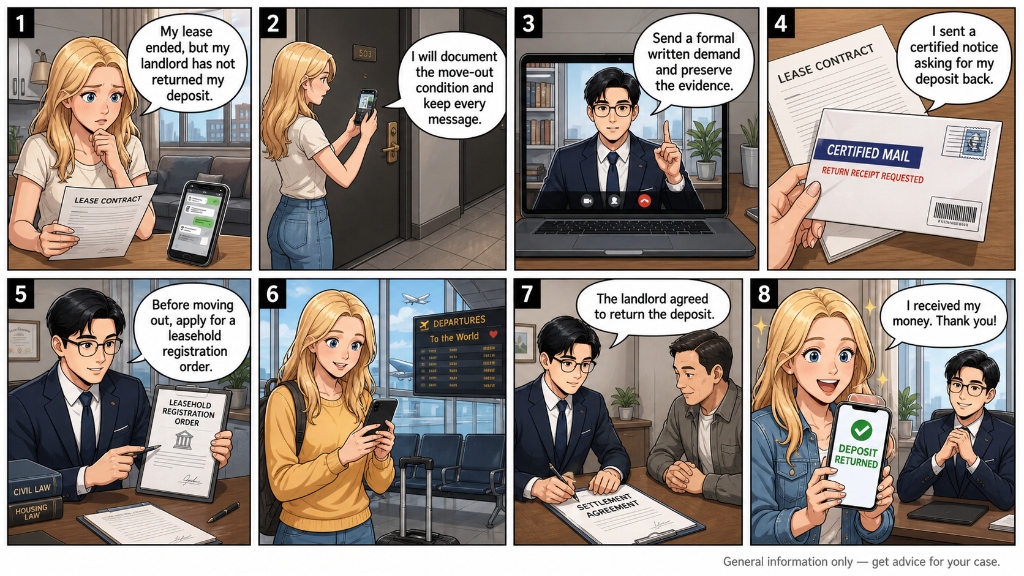
While text messages or KakaoTalk notifications are legally recognized if the landlord acknowledges them, sending a formal Content-Certified Mail via the post office is highly recommended. It serves as irrefutable court evidence that you declared your intent to vacate and demand your deposit on a specific date.
The ultimate leverage: Leasehold Registration Order
If you must vacate the apartment to return to your home country or move to a new residence, you ordinarily lose your opposability because you no longer occupy the property. To prevent this, you must file a Leasehold Registration Order at the district court.
Once the court grants and registers this order, it is inscribed permanently onto the building's public register. This red flag alerts all future renters and banks that the landlord has failed to return a deposit, making it nearly impossible for the landlord to secure new tenants or bank loans. More importantly, it preserves your priority claim over the property even after you move out and hand over the keys.
Step-by-step checklist to recover your deposit
- Send a formal written notice of non-renewal to the landlord between 2 and 6 months before the contract expiration date, demanding return of deposit.
- Verify that your residency report is active and your lease contract has a valid Secured Date stamp.
- If the deposit is not returned on the expiration day, do not surrender possession of the property (do not return keys or empty the apartment completely) before obtaining professional legal counsel.
- Draft and send a Content-Certified Mail detailing the default, warning of legal interest rates, and outlining impending litigation costs.
- File a Leasehold Registration Order with the local district court. Wait until the registration appears on the public land register before moving out.
- If the landlord continues to default, file a Civil Deposit Recovery Lawsuit to secure an enforceable judgment to seize landlord assets.
What you can recover from the landlord
Civil Deposit Recovery & Settlement
N/A for typical civil recovery (unless fraud is involved). Refer to civil remedies below.
A deposit recovery is primarily a civil action. However, if the landlord rented the property with intentional deception (e.g., hiding foreclosure status), criminal fraud charges may be pursued.
Full Deposit Principal Amount
100% of the key money defined in the lease contract.
Fully recoverable. The landlord cannot arbitrarily deduct funds for normal wear and tear of the property.
Delayed Interest Penalties
5% per annum until complaint served, 12% per annum during active litigation.
Interest starts accumulating the day after the contract expires, provided the tenant has surrendered the property or offered to do so.
Legal Costs and Attorney Fees
Recoverable up to limits set by Supreme Court regulations.
Upon winning the lawsuit, you can request the court to order the landlord to reimburse your litigation costs and official attorney fees.
Quick answers
Do foreigners have the same rights under the Lease Protection Act?
Yes. The Korean Supreme Court and immigration statutes confirm that registered foreigners who complete their foreigner registration and report their place of residency enjoy identical protections as Korean nationals.
Can I move out before the Leasehold Registration appears on the register?
No. You must maintain physical possession and keep your residency report registered at the address until the Leasehold Registration is officially inscribed on the land register. Moving out too early will extinguish your opposability.
What happens if the building is sold at a public auction?
If you secured your Priority Payment Right (Residency Report + Secured Date) before any other bank mortgages or liens were registered on the property, you are highly prioritized to recover your deposit from the auction proceeds first.
Can I pay with international credit cards or cash in Korea?
Most stores, restaurants, and taxis in Korea accept international Visa, Mastercard, and AMEX. However, public transportation card recharges (T-Money) and traditional street food markets require Korean Won (KRW) cash.
Is there a 24/7 English tourist helpline in Korea for urgent questions?
Yes! The Korea Tourism Organization operates the 1330 Korea Travel Helpline, providing free 24/7 assistance in English, Japanese, and Chinese for directions, translation, and tourist complaints.
Reviewed by
Attorney at Law, licensed in the Republic of Korea
Bubshin Law Firm