Not legal advice. This is general information, not legal advice. It does not create an attorney-client relationship.
Key facts
- Foreign workers in South Korea have identical legal rights to Korean citizens under the Labor Standards Act, regardless of visa status, nationality, or employment type.
- If an employer defaults on wage or severance payments, workers can file a petition with the Ministry of Employment and Labor (MOEL) to obtain an official Legal Confirmation of Unpaid Wages.
- Through the Korean government's Substitutive Payment System and civil court enforcement, workers can recover up to ₩10 million directly from government funds, even after returning to their home country.
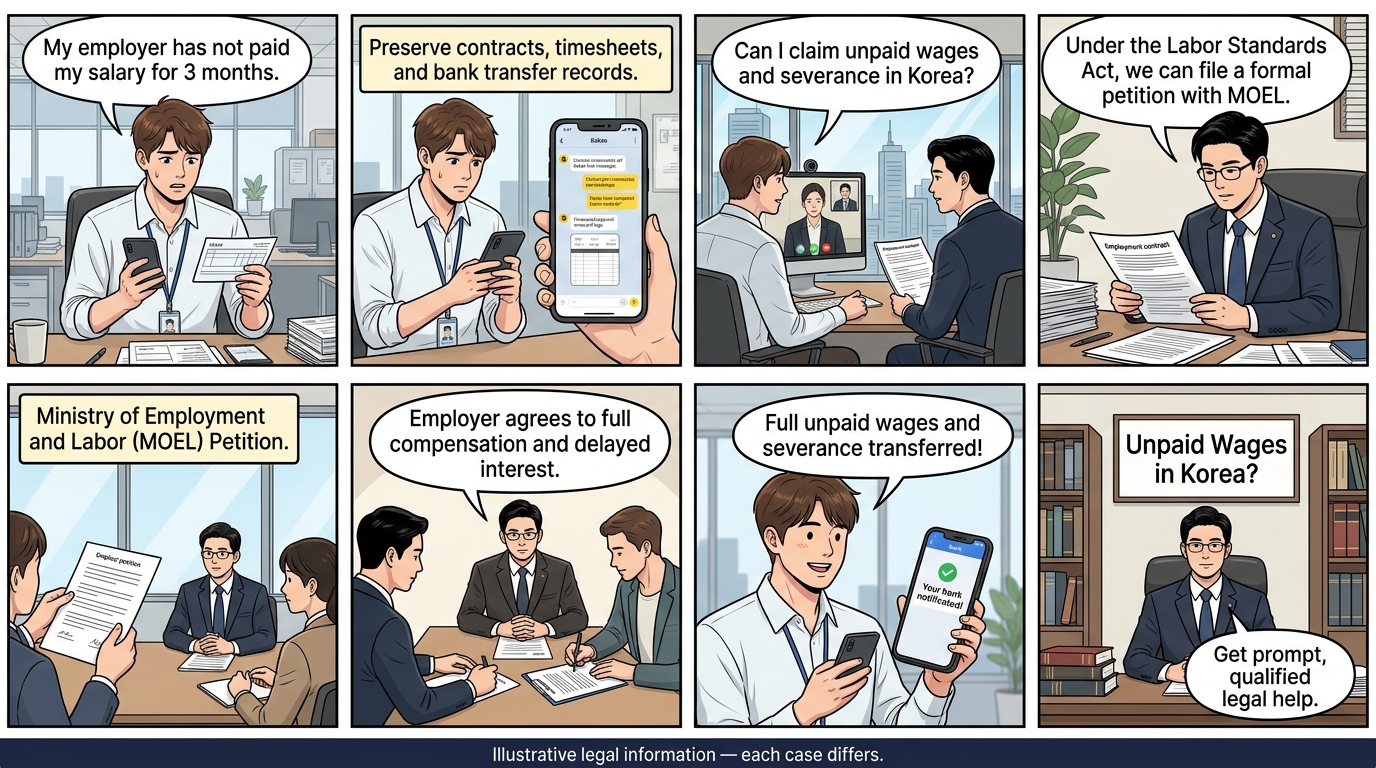
Full Protection Under the Labor Standards Act
South Korea's Labor Standards Act guarantees equal treatment for foreign workers. Under Korean law and Supreme Court precedent, statutory protections regarding minimum wage, overtime premiums, and severance pay apply to all individuals who provide labor in exchange for wages, regardless of citizenship or visa legality.
Wages include not only your contractual monthly base salary, but also mandatory premiums for overtime work (150% of base hourly rate), night shifts (10:00 PM to 6:00 AM), and weekend/holiday shifts. Furthermore, any worker employed continuously for 1 year or longer with average weekly hours of 15+ is legally entitled to Statutory Severance Pay, roughly equivalent to 1 month's average wage per year worked.
Step 1: Filing a Petition with the Labor Office
When an employer fails to pay wages or severance within 14 days of resignation or regular payday, the primary remedy is to file a formal petition with the local Ministry of Employment and Labor (MOEL) office having jurisdiction over the workplace.
A Labor Inspector will be assigned to investigate the claim, auditing bank records, timecards, work schedules, and messaging communications. If wage theft is confirmed, the inspector issues an official order to pay and grants the worker an official Legal Confirmation of Unpaid Wages, which serves as conclusive legal evidence in court.
Fast Recovery: Government Substitutive Payment System
If the employer refuses to pay or claims financial distress, foreign workers do not have to wait through years of litigation. Under the Wage Claim Guarantee Act, the Korean government operates the Simplified Substitutive Payment System.
Once you receive the Confirmation of Unpaid Wages from the Labor Office, you can apply directly to the Korea Workers' Compensation & Welfare Service. The government will payout up to ₩10 million (up to ₩7 million for unpaid wages and ₩7 million for severance) directly into your bank account, and the government subsequently pursues the employer for reimbursement.
Criminal Penalties, Civil Lawsuits & Remote Recovery After Leaving Korea
Wage theft in South Korea is a criminal offense punishable by up to 3 years imprisonment or up to ₩30 million in criminal fines. Employers who intentionally default face criminal prosecution by the district prosecutor's office.
For amounts exceeding the government's ₩10 million cap, workers can retain a Korean attorney to file a Civil Wage Recovery Lawsuit and attach company assets or corporate bank accounts. Crucially, by granting Power of Attorney to a Korean legal representative, you can return to your home country while your attorney handles all court filings, enforcement, and international wire transfers on your behalf.
Step-by-step checklist to recover unpaid wages & severance
- Collect and secure all evidence before leaving the job: employment contract, pay stubs, bank statements, work schedule records, messaging logs, and co-worker contact info.
- Calculate your total unpaid claims: base salary, overtime/night premiums (150%), holiday pay, and statutory severance if employed over 12 months.
- Send a formal written demand or Content-Certified Mail requesting payment within the statutory 14-day window following resignation.
- File an official Labor Petition at the local Ministry of Employment and Labor (MOEL) branch office overseeing your workplace.
- Attend the Labor Inspector's investigation and receive the official Legal Confirmation of Unpaid Wages.
- Submit the confirmation to the Korea Workers' Compensation & Welfare Service to collect up to ₩10 million via the Simplified Substitutive Payment.
- If claims exceed ₩10 million or the employer defaults, grant Power of Attorney to a Korean lawyer to pursue civil litigation and asset seizure, even after returning home.
What you can recover from the employer or government
Unpaid Base Wages & Premium Allowances
100% of unpaid wages + 150% overtime/night shift premiums.
Mandatory by law. Employers cannot enforce private agreements to pay below minimum wage or waive overtime premiums.
Statutory Severance Pay
Approximately 1 month's average salary per continuous year of service.
Applies to any worker employed for 1+ year working 15+ hours weekly, regardless of job title or contract renewal status.
Government Substitutive Payment
Up to ₩10,000,000 maximum payout from Korean government funds.
Fast direct payout from the government once Labor Office confirmation is issued, even if the employer has no money.
Statutory Delayed Interest Penalties
20% per annum under Labor Standards Act Article 37.
Commercial interest of 20% annually accumulates starting 14 days after resignation until full payment is completed.
Quick answers
Does Korean labor law protect undocumented or illegal foreign workers?
Yes. The Korean Supreme Court consistently rules (Precedent 93Dada18924) that the Labor Standards Act applies to all actual labor provided. Undocumented workers have full legal rights to receive all unpaid wages and statutory severance pay.
Can I claim unpaid wages and severance after returning to my home country?
Yes. You do not need to stay in Korea during the process. You can appoint a Korean attorney or designate a proxy to handle the Labor Office application and court proceedings, receiving your payout via international wire transfer.
What is the deadline (statute of limitations) to file a claim?
The legal statute of limitations for unpaid wages and severance pay in Korea is 3 years from the date payment became due (resignation date for severance). You must initiate legal action before this 3-year window expires.
Can I pay with international credit cards or cash in Korea?
Most stores, restaurants, and taxis in Korea accept international Visa, Mastercard, and AMEX. However, public transportation card recharges (T-Money) and traditional street food markets require Korean Won (KRW) cash.
Which mobile navigation app works best in South Korea?
Due to Korean spatial data regulations, Google Maps offers limited walking and driving turn-by-turn navigation in Korea. We recommend downloading Naver Map or KakaoMap (both support English) for accurate real-time transit schedules and walking navigation.
Is there a 24/7 English tourist helpline in Korea for urgent questions?
Yes! The Korea Tourism Organization operates the 1330 Korea Travel Helpline, providing free 24/7 assistance in English, Japanese, and Chinese for directions, translation, and tourist complaints.
Reviewed by
Attorney at Law, licensed in the Republic of Korea
Bubshin Law Firm